Wednesday, March 27, 2013

Weaves 102x2 (or 6)


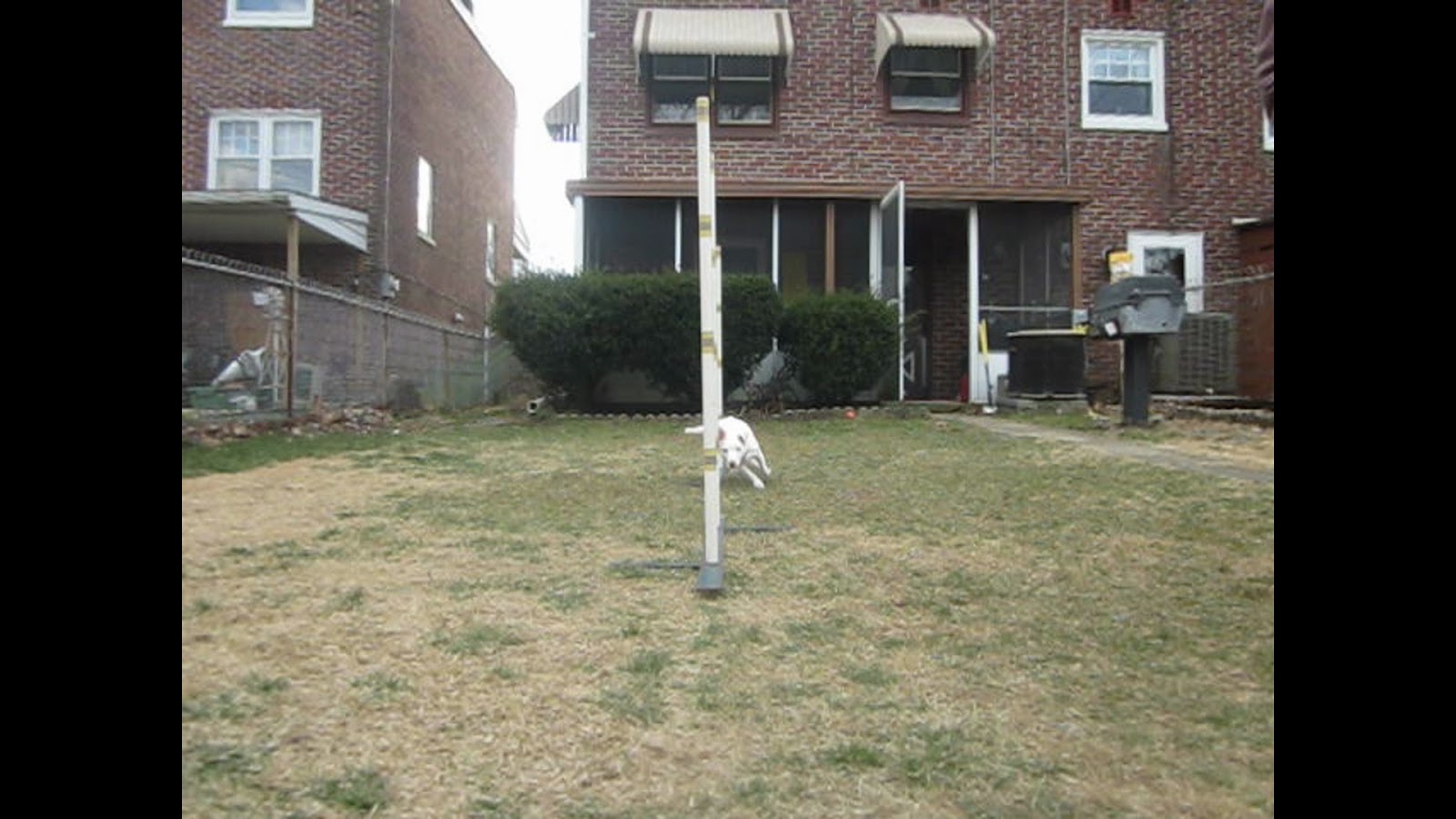
So two days ago I wrote a blog post with video clips detailing all the steps I've taken in Hokey's weave training starting from the very beginning all the way up to the point where I was ready to add the 3rd set of 2x2s for a total of 6 weave poles. Then the WORST happened! It snowed.


Okay...so it wasn't the worst thing in the world. Despite my lamenting the ceaseless winter, it actually melted quickly and I was out there the very next day (yesterday) to resume our training. And that meant adding the 3rd set of 2x2s.

I introduced the new set by placing it a few feet in front of the set of 4 poles. Then I ran her through a couple of times from both sides. Gradually I moved the new set closer and closer to the other 4 poles.


Eventually I joined the new set with the old set of 4 poles and that's when the magic happened. Suddenly I had a dog that was weaving 6 poles!


So now that I have a weaving dog, what's next? Well, I want her to have independent obstacle performance regardless of my position or motion (or lack thereof). So we will continue to do some exercises with me sending her from various locations. For example, one thing I'm working on for independence is to send her ahead of me. We struggled a little with this at first; she would do the first 3 or 4 weaves then stop and look at me because she was unsure. Most dogs, particularly green ones, find lack of handler motion a bit perplexing. But being deaf, Hokey is probably a little more reliant than the average dog on my motion and/or keeping me in visual range. But we worked through it. Here she is sending ahead of me to complete the weaves. The fact that she is willing to go on ahead of me to complete them is a huge step. The confidence will come.


I will continue to do some Around-the-Clock exercises to work on difficult angles of entry, as seen here:


I will also be introducing motion and handling into the picture at this stage. Once Hokey is confidently performing 6 weaves independently with and without motion and consistently hitting her entries from all angles of approach, I will introduce a 2nd set of 6 poles and work up to the full set of 12.

Monday, March 25, 2013

Weaves 101 (or 2x2)


Searching for spring
I had put off training Hokey's weaves for several months because of winter. In my opinion, to properly train weaves and progress quickly, you need to be able to work a little bit each day. Winter brings cold temps and the possibility of varying amounts of snow and, since I don't have the space in my house to set up 6 weaves, never mind a full set of 12, I decided to put it off until early March thinking I'd be safe weather-wise by then. After all, last year by mid-March, it was 80 degrees and I was mowing my yard. Looking out my window today on the 25th, with the snow coming down and a couple of inches already on the ground, I'm questioning the wisdom of my decision. However, I've already invested a little over 2 1/2 weeks into the process. Hopefully this will melt quickly and not affect our momentum and the progress we've achieved thus far. And I guess if I can't be out there training, I can at least write about it.

I had great success using the 2x2 method of weave training with Poppy a couple of years ago, so decided to use it again to train Hokey. However, with Poppy, I had used the "older" method where the 2x2s are set at angles and gradually moved to the straight position -- like channel weaves. This time, I decided to use Mary Ellen Barry's 2x2 method instead. An article outlining her method was published in the April 2009 issue of Clean Run and can be found, here, on the KineticDog website. This method puts the emphasis on teaching correct entries from multiple angles of approach. The sequence of screen capture snapshots below show Hokey approaching and entering the weaves from a sharp angle that requires her to wrap around the 1st pole, thereby demonstrating her understanding of what constitutes a correct entry even at this early stage in her training:


I wanted to document our progress, not only for the sake of this blog, but should I be in the position to be training another dog sometime in the future, it will be there to help guide me through the steps again. I suspect Hokey's progress, although not slow by any means, may be slightly slower than the average dog due to her deafness. I don't really want her looking at me as I want her focus to be on driving forward. Yet she is unable to receive any kind of auditory feedback, so she must rely on learning more by trial and error than a dog that can hear would. She does have a fairly low threshold for frustration though, often expressed with a loud snort, which requires us to take a break and do something else.


I believe I started Hokey with step 1 on March 6th or 7th and I did not document this step with video. It simply consists of shaping the dog to pass through the poles of a set of 2x2s by standing at one end and tossing treats for the dog whenever it passes through the 2 poles. Direction doesn't matter at this point. You simply want the dog to understand the value of passing between the 2 poles. However, you want to move quickly to the next step once the behavior has been established.

Step 2 begins by establishing direction - i.e. the dog learns that from now on the correct way to enter the weaves is with its left shoulder passing the 1st pole. At this point you always want to have your dog approaching the 2x2s from one direction; you do not want to turn around and come at them again from the direction you just came (i.e. "back weave"). Because of cold rainy weather, I began the 1st couple of steps in my basement, which is plenty big enough for the first couple of steps, but unfortunately appears to have been last decorated circa 1978.


Once direction is well-established and your dog is consistently hitting the entry you can move on to part B of step 2 which teaches your dog to wrap around the 1st pole at increasingly sharper angles of approach by gradually moving the 2x2s from a straight on approach to a perpendicular approach. Here is Hokey demonstrating this step:


Once the dog is successfully hitting the entry to the 2x2s at the above stage, you can start to move on to the Around-the-Clock work. The first stage consists of you and your dog moving around the set of 2x2s as if they were set with the 1st pole pointing toward 6 on a clock and the last pole pointing toward 12. You and your dog work all angles of approach in an arc from 6 - 11 clockwise and 6 - 1 counterclockwise. At this point you always have your dog by your side and may do a restrain and release.


The next step is to work Around-the-Clock positions where you are stationary but releasing the dog from various positions that don't require any actual handling. The following video shows me working Hokey on both sides from ONE of these positions. I had trouble with my spare camera battery dying on me, so was not able to capture some of the other positions, but the Clean Run article mentioned above shows the positions to work on.  


Once the dog is hitting the entry well from the various positions, it's time to add another set of 2x2s. To do this, first place the 2nd set in line a few feet from the 1st. Send the dog through the first set and reward immediately after. Then send the dog through the second set.


Quickly fade the reward between the two sets then reward the dog for  performing both sets together. Even though the dog is performing both sets at once, they should still be considered two separate obstacles, so you are actually moving with your dog to the 2nd set instead of remaining stationary.


Once the dog is moving through both sets of 2x2s, start all of your Around-the-Clock work again both with the dog at your side and then releasing from various positions.


Next, gradually start to move the 2nd set closer to the first and repeat the steps above.


Eventually the 2 sets of 2x2s come together and you start to see something that looks like weaving! Continue to work the various positions like here:


And here:


So that's where Hokey's training stands as of now. I believe I am ready to introduce the 3rd set of 2x2s into the mix so we will have 6 poles. That is, IF it stops snowing and it all melts away. 


Wednesday, March 6, 2013

Internationalization: Raising the Bar or Building Barriers?

This is my second contribution for a Dog Agility Blog Action Day and the topic this time is internationalization. That is, the increasing influence of European style course designs and the increased adoption and execution of new, somewhat complex, handling maneuvers. I've been thinking long and hard about what I wanted to write and when it came down to it, I really struggled with what to say. The truth is, I have very mixed feelings on the internationalization of the sport.

On the one hand, I love to learn new things and challenge myself. Admittedly, I'm not the most graceful handler in the world and sometimes feel like a dancer with two left feet (and two left arms) when learning some of these fancy moves and attempting to put them into action. I have to break them down into pieces and slowly put them together again before spending time working on my timing with my dog in order to be able to successfully execute them. The truth is, I'm unlikely to incorporate some of these moves into my repertoire in a trial setting at this time. Keeping it simple tends to work best for me. But I never say never and who knows? When Hokey and I come together as a team in the future, I might be out there tossing in Ketschers left and right.
  
I admire and appreciate watching teams successfully maneuver their way through a highly technical course. With Ollie by my side, I've enjoyed tackling the more difficult courses. I'd much rather run him on a technical course than one built for flow and speed. I admit, it's a rush to make it through a challenging course clean and be one of the few to earn a Q. And I'm looking forward to seeing what Hokey will do on such courses someday. She's building a good foundation in backsides and other maneuvers that will translate into some tight turns and being able to respond to some pretty fancy handling moves.


On the other hand, I do see some negative consequences resulting from the increase of international influences. Not the least of which, they are not necessarily right for every dog/handler/team. I happen to have a dog like that. Poppy. I know she is capable of executing technical courses and responding properly to some of the newer, complex handling moves. A couple of months ago, we took a brief class focusing on just that and she did beautifully. We Jaakko'd and Ketschered and blinded and back-sided our butts off. Put her in a trial situation however, and it would be a different story. Because her environmental sensitivities go haywire in a trial setting, the more flowing the course and the less handling I have to do, the better off she is. Too much technicality in the course or too much handling required on my part results in a stressy, disconnected dog. She is not the only dog like this. For some dogs, the optimal course is a flowing, forward moving one where they can hit a rhythm instead of constantly and rapidly having to switch back and forth between extension and collection and making a bunch of tight turns.  Yes, I am fortunate that, should I ever decide to get her going in agility again, I have a range of venues to select from and can choose one where I would encounter more flowing courses. Not everyone lives in a venue rich area like I do, however. I worry that as the international elements become the norm, some handlers with dogs who are not motivated by these types of courses and have a tendency to shut down when encountered with them, will become discouraged and will no longer want to participate in the sport.

Which brings me to another, more general, concern. Will the increasing influence of internationalization of the sport create a schism between the serious competitors with eyes toward big achievements in the realm of national and international competitions and those who simply participate for the love playing the game with their dog and who have smaller goals and aspirations? Will certain venues cater more to those serious competitors by continuing to incorporate international course design elements to the point where they become known as venues for elite teams only? Will the newer or more casual competitors feel alienated as a result? I don't know. I hope not. But I fear I may have already witnessed this slowly creeping into the sport. I understand that, in part, this is just the natural evolution of the sport. However, I would hate to see agility completely lose touch with its roots and become a sport only for elite handlers and their dogs.

Lastly, I worry about the physical effects on our dogs as we ask them to perform more and tighter turns while pushing for greater speeds. Are there more injuries occurring as these elements become more common? No handler is 100% perfect. With more severe angles on course and tighter turns required, a slight misjudgement in timing has the potential of causing harm. Just because it can be done, does that mean it should be? What is fair and reasonable to ask of a dog in this sport?

In sum, I truly have mixed feelings about the increasing influence of internationalization in dog agility. I, myself, love to run the more difficult courses and learn the new handling moves, but, at the same time, I am concerned about alienating and discouraging teams from participating in the sport and also about the physical effects the demands of these courses are placing on our dogs.

To read what others have to say on the subject of internationalization in agility, please visit the Dog Agility Blog Events page on the subject.


Monday, March 4, 2013

The ORT Experience


This past Saturday, Ollie and Poppy participated in their first official nose work event. It's called the Odor Recognition Test or ORT. ORTs are sanctioned through the National Association of Canine Scent Work (NACSW) and are the first step toward competing in nose work trials. NACSW trials have 3 levels and each level adds a new odor for the dog to learn. In order to verify that the dog knows the odor it will be searching for in competition, it must pass the ORT on that odor prior to being allowed to enter a nose work trial. For nose work level 1 trials, that odor is birch. My January post on nose work shows Ollie and Poppy working searches on birch odor. The ORT not only demonstrates that the dog is able to recognize the target odor for which it is being tested, it also tests the communication between handler and dog - i.e. the dog displays some sort of behavior to indicate where the odor is hidden and the handler is able to read the dog and and say "there it is". Or, actually, the official verbal statement that must be given in an ORT is the word "alert".

First, it it important to understand that, unlike agility, nose work is NOT a spectator sport. In fact, it is the opposite. Because of the sensitive nature of the location of the hidden odor, every effort is made to keep that information from leaking out. The only people in the building when the test is running are the judge, the NACSW certifying official and the few people working the trial: the timer, gate steward, ring stewards (at least one to reset any non-odor boxes moved by the dog being tested and another that only resets the box containing odor if needed), etc. Competitors are told to primarily stay in their vehicles while they await their turn and after they go through the test they are told only to let people know if they passed or not with a thumbs up or a thumbs down. They should not discuss anything about the test conditions themselves.

When you check in, you give the ORT secretary the dog's official NACSW scorebook for the results to be recorded. Then there is a briefing giving you all the basic information on what to expect.
Poppy & Ollie's scorebooks
Like in agility, there is a gate sheet with a running order. There is also a "warm up" area where a small number of boxes are put out, one containing odor. You can practice on these shortly before going in for your test so that your dog understands what it's there to do. You may also use them for "recovery" purposes after the test, but warm-up teams have priority.

The gate steward calls you into the building when it is your turn. You are allowed to bring one person with you to record your test. If you have such a person, they are actually escorted into the building ahead of you and seated before you are allowed to go in. This is to minimize the distraction to the dog being tested. When called, or once your guest is situated, the gate steward escorts you into the building and takes your coat and anything else you don't want on your person or dog while testing, then asks you if you have any questions. After that, it is EXTREMELY quiet in the building. You walk to the startline where you may pause for a maximum of 10 seconds. No one will tell you to "go". Like I said, it is quiet. And purposely so. It's about you and your dog concentrating on the work without a lot of other distractions. The time starts as soon as the dog's nose crosses the startline or after the 10 seconds at the startline runs out.

The test itself consists of 12 identical boxes set a minimum of 48" apart. They may be set in a pattern of 2 rows of 6 or in one long row. One box contains 3 cotton swabs with the target odor (in this case, birch). It remains in the same location for all dogs being tested on that odor so that it is concentrated in one spot for the entire test. As a verification of the test, a "dog in white", i.e. a dog who has already passed the ORT on the odor being tested, is brought in for a trial run before the dogs being tested are run.

Then the real test begins. As the handler has no idea which box is the one containing odor, it is up to the dog to indicate the correct box to the handler, at which point the handler calls out "alert" stopping the time. You are given up to 3 minutes to call the alert. If you call the alert on the correct box, you will be told "yes" immediately by the judge and then quickly reward your dog with food or a toy. Then you go to the judges table for your booklet, which will be marked with a "pass" and signed by both the judge and the NACSW certifying official. Lastly, you are met by the gate steward to collect whatever belongings you left with them and are escorted out of the building to give the thumbs up to anyone who cares to know your joy.

If you call out alert on the wrong box, say if you have trouble reading your dog and incorrectly think they are indicating when they aren't or if the dog gives you a false positive, you are told "no" then told which box is the correct one. You are to go directly to that box and reward your dog there. Then you go to the judges table to get your booklet where the result is recorded as a "miss" and must try again some other day.

Unfortunately, I did not bring anyone with me to tape Ollie and Poppy's ORT runs. However, my friend Marilyn was gracious enough to let me use some clips of her sheltie, Mia, doing some practice runs at an ORT run-thru that the club hosting this past weekend's test had held a couple of weeks before. I thought it would be useful to show these in order to demonstrate the basic set up of an ORT. Note that the background, although relatively quiet, is still much busier and noisier than it would be in an actual ORT situation, where you can pretty much hear a pin drop. Here are 2 clips of successful practice runs. Notice the indication behavior:


And here is another practice run, but this time Mia presents a false positive by indicating the wrong box for whatever mysterious reason. In an actual ORT, Marilyn would have been told which box was the correct one and would have had to immediately proceed to it. But, because this is just practice, she continues to search until Mia indicates on the correct box.


My own experience with the ORT started to really fall into place a few days before. I've been crazy-busy at work and have been putting in some overtime and just didn't think I could manage to make it out to a store to buy a red bandana for Ollie. A red bandana is the conventional signal in nose work to let others know that the dog is reactive and they should keep their distance. I sent a plea for help out to my co-workers asking if anyone had a red bandana I could borrow for the weekend. I quickly received 2 replies, so that was covered and one thing I could check off my list. (I found out at the ORT that the host club also had some extra bandanas available for our use if needed). Then it looked like Ollie's replacement harness (I had returned one for a bigger size) wouldn't arrive from Clean Run in time, so I was faced with either working him in the cheap one I've been using that makes him walk like he's in a straight jacket or risking his embarrassment by having to share Poppy's hot pink harness which would have clashed with his red bandana. By some miracle, the replacement harness was waiting for me when I arrived home from work on Friday.
A surprise to me - despite the significant height difference they actually wear the same size harness. Does Ollie look embarrassed trying on Poppy's pink harness?


Ollie lookin' sharp sporting his new harness & red reactive dog bandana
Their ORT practices had been going well. Even Ollie, who has 8 years or so of heavy reinforcement for 101 Things To Do with a Box and so has a tendency to goof around offering behaviors on boxes instead of using his sniffer, was giving me excellent search results.

Friday night, Poppy was so excited about something happening the next day, she kept waking me up as though she was saying "Is it time to leave yet?".

Obviously, since the odor box being used in the test does not move and I would know where it was after running my first dog, I could not test both Ollie and Poppy in the same ORT. Luckily, this club offered an AM test and a separate PM test. Ollie was 3rd dog on the line in the morning test. What was supposed to be a nice, sunny day turned out to be a cold and blustery one with occasional snow spitting from the sky. I had brought some birch odor with me and put it in a small box. I let him sniff it a few times while rewarding him with food, but he started to nose target rather than actually sniff, so I stopped that. I brought him to the warm up area and ran him through twice. The result was iffy; he was really offering behaviors rather than truly using his nose. So I hoped for the best and went to wait my turn in the freezing cold wind.

Our turn came and we were called in to the building. I handed my coat to the gate steward and headed across the floor to where the startline was set up. Once there, I paused, took a deep breath, made sure Ollie was looking at the 2 rows of boxes in front of us and then said "find it". As soon as I saw him sniff the first box and head for the second, I could tell he was actually working, so I relaxed a bit. When he came to the 3rd box, as he started to bypass it, he suddenly pivoted back around, put his paw on the box, looked up at me, then dipped his nose in for a target. I felt that was a pretty clear indication so I called it. The answer was YES!!! I was so elated and proud of my dog! He got a big reward. It had happened so quickly, either the NACSW official or the judge asked the timer how long it had been. The answer: 5 SECONDS!! Amazing. I collected my booklet with the "pass" and signatures and my coat and walked out the door. Someone helping outside of the test gave me a questioning look with a thumbs up and I smiled and nodded. Then ran back to my car to lavish praise and treats on Ollie-Ollie-Good-Dog.


After spending about 3 hours trying to stay warm in my vehicle, it was Miss Poppy's turn to show her stuff. She was first dog on the line in the afternoon test. I was a lot more nervous when it came to her. Poppy is the better nose work dog of the two, however, she suffers from severe environmental sensitivity. She gets very anxious in new settings and then loses her ability to focus. I had no idea what to expect. Her behavior in the warm up area did not encourage me. Instead of working, she just wanted to paw and knock the boxes around. Any boxes. Odor or not. Then when I went to the gate to wait to be called, she was very unfocused and doing a lot of stress sniffing on the ground. She was still not herself when we were called into the building. Normally when we do nose work, she can hardly contain her excitement. She barks loud and a lot. She strains at her harness and leaps around in the air. This Poppy was quiet, unfocused, and sniffing at the ground. When I got to the startline, she wasn't even looking at the boxes in front of her. I paused a few seconds until she was facing forward then gave her the "Find It!" command and she started off down one of the rows of boxes. I was encouraged that she was sniffing each box as she worked down the row, but still worried. When she came to the 5th box in that row, she started shoving it across the floor then placed a paw on it. I called the alert. The answer: "YES". Woo-Hoo! They were impressed with her speed and, just as with Ollie, asked for the time. She had alerted in just over 7 seconds! Another amazing run.

I couldn't be more pleased or proud of my dogs. And relieved!
 
Booklets showing the "pass" on ORT for both dogs


Now that they are both eligible to enter Nose Work 1 trials, we will get busy refining our work on the 4 elements tested in a trial: container, vehicle, interior and exterior searches. Stay tuned for more nose work fun in the future.

Ollie was super happy about passing his birch ORT with flying colors

Thursday, February 28, 2013

Flying Frame Update


Just a quick update from what I posted a few days ago. I worked Hokey on the A-Frame again today and concentrated on getting her to jump the apex, rather than scrambling over it like she was doing on Sunday. I placed a jump bar at the top of the frame to encourage the behavior and it seemed to work the majority of the time. It looks like she's getting 2 strides on the upside rather than the 3 she was getting on Sunday. However, on the decent, she is putting in a short stride between landing over the apex and pouncing into the box. I guess I'll see if that starts to fade as she gets more experience and gains more confidence. I think this is pretty good for only her second time on the frame though.


Monday, February 25, 2013

3-2-1 Contact Training (with Serps & Pinwheels too)


 Hokey's agility training has been coming along. While (im)patiently waiting for spring to arrive, I've recently been able to get access to a nice building and equipment to practice on once a week. And it's only ~10 minutes from my house. Deb Goodhart rents the building about once a month to give lessons, so we've been doing that as well. I'm so appreciative to finally have an opportunity to do some training that doesn't involve traveling to the ends of the earth!


I put together a couple of clips of just a few things I was working on during our practice sessions. The first shows us doing some rear cross on the tunnel work, learning to drive through the chute and just fooling around running a little sequence -- a "real" one.


The following week, I worked her on some serps. It was only the 2nd time she'd done real serps. The first had been about a week before in my backyard. We still need a little work on timing and teamwork and her ability to consistently read the serp RTH when I add motion, but I thought she did stunningly overall considering how green she is. I also show a bit of a rear cross exercise at the end of this. Rear crosses are something we are still working hard at and still need a lot of work, but I was happy with what she did here. It's coming along. I was doing some exercises with her in my backyard this evening and after a small initial struggle, she started to really pick it up well. We'll continue to work at it.


Hokey has had a couple of initial introductory sessions on the teeter now, with the ends set on tables. During the first session, we just let her run back and forth to get treats at either end. Then we dropped one of the tables so that one end had about a 12" drop. She was unfazed. She couldn't seem to turn around fast enough to run to the other end to get her treat, even if it meant jumping up on the end and riding it down first. Of course, being deaf, the banging noise is out of the picture for her. But the motion doesn't seem to worry her.

Here is the end of our second session on the teeter. I am not teaching her any "end behavior" yet, however I am trying to train her to pause on the table at the end of the teeter as I move ahead. Since she is relatively fearless and tends to be at the "less" end of the self-preservation scale, teaching her to use her brakes now is probably a good idea. So here she is playing her favorite teeter ping-pong game:


She's been working the A-frame grid well for some time now, although admittedly I haven't been able to do it consistently during the winter months. But every time we do work it, she's been working well. So I decided it was time to introduce the actual A-frame into the equation. We've played the "mountain climbing game" on one side of the frame a couple of times to build up her hamstrings and teach her that she's able to control her decent. And she's run over it a couple of times at full height on the way to something else of her own accord (deaf dogs simply don't listen to "Don't do that until you've been trained how" and the "uh-uh-uh" as they forge ahead with their own agenda). But for a true introduction, we lowered it and I put my PVC box on. The first couple of times up and down, she was pretty tentative and unsure, like here:


So we decided to set up the ground grid next to the frame to remind her of what it is all about and give her muscle memory a boost.


That was all fine and good, so I switched back to the frame. Or at least I tried to. Suddenly, she was all "Frame? What frame? I don't see any huge, looming piece of wood directly in front of me". Even when Deb tried a restrained recall, she did a run-around.


Then she finally took the plunge up and over, proceeding to leap completely over the contact zone and box. But...she did a great job tackling the frame.


So now we were ready to put it together. As you can see, Hokey hasn't made the connection and generalized the striding from the ground grid to the frame yet. She's still getting used to the idea of running up and down it at this point. I know she's capable of opening up her stride more and she needs to learn to leap over the top rather than scrambling over and down until pouncing through the box, as she's mostly doing here. She may need a jump bar or something clamped to the top in order to help aid her in transferring the striding she learned on the ground grid to the frame. We'll see. But this isn't too bad considering it's the first time working the frame for this wee little pup.


We also worked some pinwheel exercises in my lesson this week. Since we are new to sequencing and with Hokey still being VERY green, her obstacle commitment is not always there and she apparently still needs quite a bit of support. I'm sure this will lessen as she gains experience and confidence. Here we are doing a straight pinwheel. Without a lot of support, she is pulling off jumps instead of committing:


Here we are doing the exercise without the send to the middle pinwheel jump, so that she understands that where I place my body relative to the plane of jumps tells her whether to take the pinwheel jump or not. Not taking the pinwheel jump isn't a problem, but she is so sensitive to my pulling motion that she almost misses the 3rd jump without me giving her a little extra push back out to it.


 Next, adding a front cross between jumps 4 and 5 after the pinwheel. I spent too long supporting her pinwheel jump and was late for my cross the first time through. The second time was much better. Of course, part of training a new dog, especially when you start to put it together and run some sequences, means learning how to come together to work as a team.


Then we did the pinwheel with blind crosses. The first run was pretty nice. I was a little too early on my cross in the 2nd run. The 3rd was much better timing-wise, even though she ended up dropping the bar.


Our last blind cross ended up being pretty nice though. Bonus: she doesn't even look at the off-course trap jump set up near the 3rd and 4th jumps:


We haven't started any training for the dogwalk and haven't even been able to resume the groundwork for that was put on hold for the winter. (confession: in another don't-try-to-tell-a-deaf-dog-no moment, she has been up on the full height dog walk of her own accord a couple of times. Like I said, she is fearless. I have been VERY conscious of keeping her away from the full-height teeter however).

I plan on starting 2x2 weave training sometime in March.


So that's the update on Hocus Pocus training. More to come soon as the warmer weather allows us more training opportunities! 

Wednesday, January 30, 2013

Rainy Day and My Backyard-is-a-Bog Training

Hokey planted herself in front of the heat vent. It was cold!

This will be a short, but sweet post.
Between the weather being horrendously cold last week...
then snowing...
then warming up so dramatically the snow melted in less than a day...
then raining buckets...
so that my backyard has become a virtual bog,
I haven't had much opportunity to do any real training with Hokey.

What to do?

How about shaping a random behavior?
I am using a flashlight as my substitute clicker.